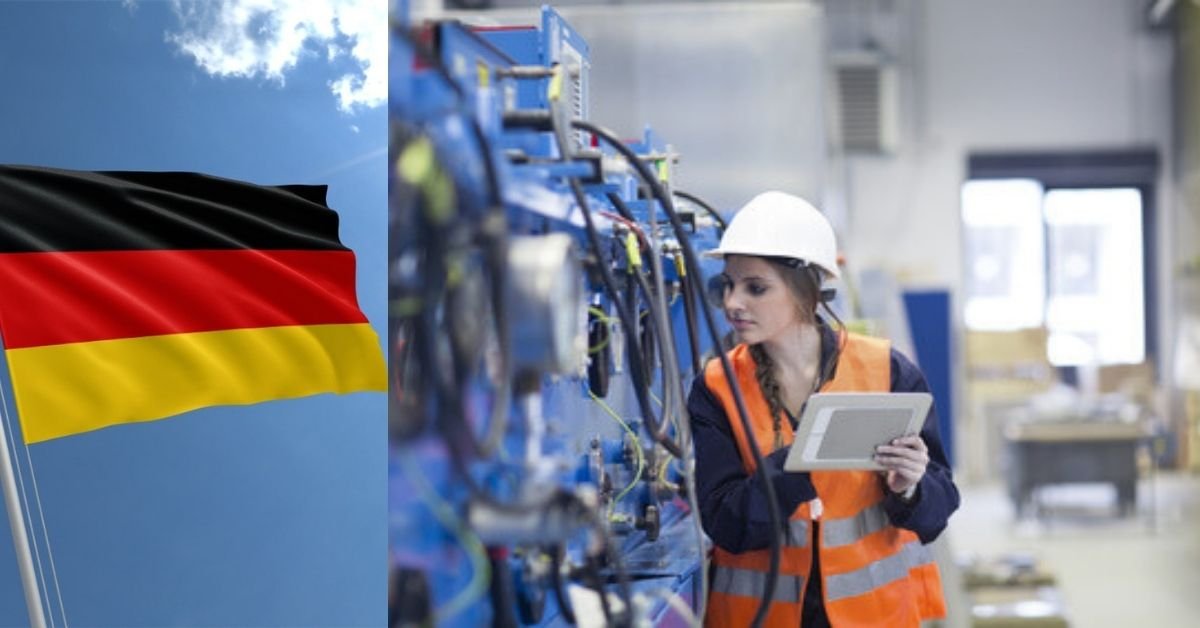
Germany Skilled Labor Shortage 2026 – Job Insights
The reason why, in spite of global economic changes, Germany continues to roll the red carpet to international talent in 2026, do you wonder? The solution is an organizational phenomenon: the Fachkraffetmangel (skilled labour shortage).
In order to maneuver in the German job market in 2026, one will have to go beyond generic job boards. The “Skilled Labor Shortage” is not simply a media trope; it is a structural economic fact that is characterized by given legal conditions and the high-skilled industries. This guide can give you the strategic insights that you can use to convert that talent gap in Germany to your career opportunity.
Important Visa Significant words- Legal
These are the keys that pave way to international talents. In 2026, mass hiring is a thing of the past and the emphasis has been on structured recruitment.
- Chancenkarte (Opportunity Card): The 2026 flagship points-based visa that will enable one to seek jobs locally within a period of up to one year.
- Mangelberufe (Shortage Occupations): The official list of more than 160 occupations which have lower wages amounts of the EU Blue Card.
- Fast-Track Procedure section 81a: This is the paid service (€411) and in this case, your employer expedites your visa application by the local authorities, which may speed up the process by several months.
- EU Pay Clearness Leading: A revisited deprecate update of 2026 will authorization employers to create salary ranges in job announce, giving international treated a stronger laborer.
- ZAB Statement of Comparability: The certificate that will prove your foreign degree is equivalent to German education.
High-Demand Industry (The “Crisis” Sectors)
Although the mainstream industries, such as the automotive manufacturing sector is reorganizing now, these bottleneck areas are in dire need of skilled employees in the year 2026.
Healthcare & Geriatric Care
The main force here is the graying population of Germany. Astute professionals have predicted that more than 40,000 new nurses and care assistants will be required in the year 2026 alone.
- Better positions: Certified Nurses (B2 German essential), Physiotherapists, and Geriatric Care Specific.
MINT / STEM & Digital Transformation.
The tech industry is also on a boom but instead of the hiring boom, there has been what is termed selective hiring as a result of specialized skills.
- In Demand: AI Technologist, Cybersecurity Experts, Cloud Designer (AWS/Azure), and Data Scientists.
Green Tech & the Energiewende
With Germany reference at 80% of its electricity approaching from renewable beginning by the year 2030, the Green Jobs activity is prospering.
- On Demand: Solar techs, HVAC installers (heat pump experts), and Energy engineers that are sustainable.
Skilled Trades (Handwerk)
Small and medium-sized business (the Mittelstand) is the heart of Germany and has the greatest number of vacancies.
- Best Needs Electricians, plumbers, industrial mechanics, civil engineers.
Economic, Demographic Trends: The Why.
When you know the statistics behind the shortage it will assist you in positioning yourself as a long term solution and not a short time solution.
- The Retirement Wave: Baby boomers will retire at the highest level between 2026 and 2030. It takes approximately 400,000 foreign workers per year to stabilise the economy of Germany.
- The Growth Brake: A recent DIHK report refers to the labor shortage as a two-fold brake on growth, the capital is available, the demand is available, but they are just short of human hours to work.
- Selective Hiring: In 2026, employers are going to hire slowly, unlike 2022. They are seeking career changers (Quereinsteiger) who have transferable skills and that possess strong language backgrounds.
Actionable hints of 2026: Match over Quantity.
Successful in 2026 is all active Match over Concept. Employers are hiring not fast but smart.
- Tabular CV: You should make sure that your resume is in the chronological, tabular format (Lebenslauf) that favorable to German HR managers.
- Language Proof: In which level of CEFR did you mention (A1 – C1)? When it comes to IT, English is widespread, but the B1/B2 German is considered as the gold standard when it comes to securing a job in 2026.
- Role Mission: What to do is not the question; what is your Impact? German organizations are shifting to the concept of “Result-Based” recruitment to fight off productivity loss.
FAQs
Rapid skill drainage: Is the skill shortage over in 2026?
No. Economic growth is not very high but it is structural because of demographics. This is projected to increase since millions of people will retire in 2030.
Will my English language be sufficient to get a job in Germany?
Yes, especially in IT, Green Tech and in international startups. In the case of healthcare, education and the “Mittelstand” however, German (B1+) is typically compulsory.
What will be the minimum wage in Germany in 2026?
In 2026, the national minimum wage will be around 12.50 per hour and will be about 2100 per month working full time.
Which area is the most employing one?
Bavaria, Baden-Wurttemberg and North Rhine-Westphalia are the industrial giants that have the highest vacancy rates.
Am I required to have a degree to occupy a shortage occupation?
Not necessarily for IT. When you have 3 years of related practice within the past 7 years, you can apply to IT Blue Card without having a university degree.
Final Thought
The labor market in Germany in 2026 represents a paradise of contradictions: on one hand, there will be increased unemployment rates, on the other, a cry of desperation in the face of emptiness. There is no need to worry about the economic slowdown because by matching your competencies with the Mangelberufe-list and using the Fast-Track Procedure, you could forgo the economic downturn and find a well-paying, safe position in the top economy in Europe.
Disclaimer:
This paper is both informative and educative in nature. Before deciding on a career or immigration choice, the readers are therefore recommended to confirm information with reputable sources, including the official portal to Make it in Germany or the Federal Employment Agency (Bundesagentur für Arbeit)